Julia’s Last Home & Coq au Vin

Chicken in Red Wine with Onions, Mushrooms, and Bacon
“In France it is usually accompanied only by parsley potatoes; buttered green peas could be included if you wish a green vegetable.” from Mastering the Art of French Cooking

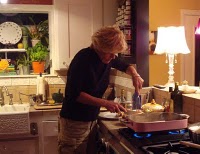
In honor of Julia’s birthday, Father Adam and I made the meal as she recommends. Our potatoes are parsleyed and our peas are buttered and tossed with chopped fresh mint.

Montecito, California

Adjacent to the city of Santa Barbara, lies beautiful Montecito. A while back my mother and I had lunch at the charming Montecito Inn.

After lunch, we decided to drive up the road to visit the Casa Dorinda to see where Julia Child (August 15, 1912 – August 13, 2004) spent her last years.

This assisted living facility is a sprawling complex, the former estate of a wealthy nature lover. Julia occupied a cozy one bedroom apartment. She decorated her little kitchen walls with cookware and tools just like she had at her home in Cambridge.

In addition to cooking and camaraderie, another of Julia’s passions was golf. I like to imagine that it gave her pleasure to have this pretty little green at the Casa Dorinda. Perhaps she played here?
Back to the kitchen and her Coq au Vin recipe…

Bacon is simmered in water, then dried and sautéed in hot butter until lightly brown. A whole chicken, cut-up, is then browned in the fat. Cognac is added to the pan.

Another reason to love Julia’s cooking – many of her recipes include lighting them on fire! Tip the pan and ignite the cognac.

After the flames subside, add 3 cups of good red wine and enough beef stock to cover the chicken. Stir in tomato paste, mashed garlic, thyme and bay leaf and bring to a simmer. This is another one of those times where I wish you could smell the aromas…Cover and cook 25-30 minutes.

Meanwhile make brown-braised pearl onions and sautéed mushrooms.

We thought Julia would be pleased that we sautéed French bread in clarified butter, in her honor, to make croutons for the coq au vin.

When the chicken is cooked, remove it to a platter then skim the fat from the sauce. Raise the heat and reduce the sauce. Beat beurre manié into the sauce to thicken, adjust seasoning. Add the chicken, bacon, onions and mushrooms back to the pot, heat through and serve.
The complete recipe from Mastering the Art of French Cooking can be found here. And oh my, the sauce was so flavorful, rich and velvety!
Julia Wisdom:
“The pleasures of the table, and of life, are infinite – toujours bon appétit!
Happy Birthday and Thank You Julia Child!
(The month of August is Julia Child Month here at TaStE WiTh ThE EyEs. I am resurrecting some prior Julia related posts as well as cooking some new Julia inspired dishes. Coq au Vin originally posted on 8.08.08).

Thank You Julia: Roast Chicken with a Natural Sauce

“A well-roasted chicken is the mark of a fine cook. Even among professionals, it is a source of pride to present a shapely chicken, with beautifully colored skin and perfectly done meat, juicy and tender. There is nothing technically difficult about roasting a chicken but there are many approaches to take…for serving either of our chickens, we suggest a delicious pan sauce.” from Julia and Jacques Cooking at Home.

The oven is preheated to 425°F. The chicken is rinsed thoroughly with hot water and dried with paper towels. Fat lumps are removed from the cavity. The small bony protrusions “nubbins” are removed from the wing-tip joints.

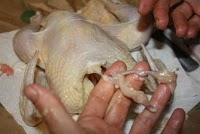
Carving is made easier when the wishbone is removed. This is done by lifting the neck skin and inserting a thin sharp knife into each end of the breast and slicing diagonally along each side of the wishbone.

The finger and thumb are used to loosen the bone, pry it out at the top, pull down, wriggling it out.

“A cooking process such as roasting a chicken is inexact – there is no one way that is the right way,” writes Julia. “Just start with a good chicken and pay attention to how you cook it.”

Voilà! The wishbone is removed!


“Not everything I do with my roast chicken is necessarily scientific,” she says. “For instance I always give my bird a generous butter massage before I put it in the oven. Why? Because I think the chicken likes it, and more important, I like to give it.”

Season the cavity with salt and pepper, stuff it with 4 sprigs of fresh tarragon and 4 thick slices of lemon. Give the lemon a little squeeze as they are inserted. Massage softened butter over the entire chicken skin and salt generously. Squeeze lemon juice over the chicken. “I learned the butter massage when I started cooking for the first time in France and would never give it up.”

The wings were folded up against the breast and the drumsticks tied together with twine. After roasting for 15 minutes, the heat is lowered to 350°F. The chicken is repeatedly basted with accumulated juices. Rough chopped carrots and onions are added after 30 minutes more. (We got nice caramelized brown bits in the bottom of the pan but had to add some chicken stock to the pan to prevent burning). The chicken is done when the juices run clear. Pierce the breast with the tines of a carving fork, press to bring the juices up, there should be no traces of pink. After about 1 1/2 hours the chicken was removed to a cutting board to rest for 15 minutes.
A Natural Sauce from the Roasting Pan

The pan can be tilted to accumulate the juices and fat in one corner, then spoon off the fat.
Julia shares, “Another aspect of roasting that is very important to me – also a lesson from my early years in France – is making the deglazing sauce from the drippings and brown bits in the roasting pan. These brown bits are the precious, caramelized natural juices, their flavor intensified and concentrated by the process of roasting and basting. When you turn these bits into a ‘deglazing’ sauce, you are preserving and essence of pure delicious chicken. There is nothing better to serve with your roast.”

Or do as we did, pouring everything into a gravy separator, then pouring the juices back into the pan, which worked great for removing the vegetables and much of the fat.

The pan is placed over two medium heat burners, 2 T. minced shallots are added to the pan, stirring briefly. Then 1/3 c. of dry white wine and 2/3 c. chicken stock are added, raise the heat to high, and cook to get the sauce to the right consistency, scraping up all the glazed bits in the pan with a wooden spoon. Taste the sauce, adjust seasoning. Strain to remove bits, add butter for a richer finish (we skipped the butter and found the sauce delightfully rich and flavorful without it).
Lauren carves the bird: Remove the trussing strings and lay the chicken on its side. Cut the skin all around the thigh and leg. Lift the leg and pull away. The thigh will break off at the hip joint. Separate the drumstick from the thigh. Then holding the fork in the breast, cut through the should joint under the wing. Slice through to the outer part of the breast. Remove the breast meat with the wing attached.
Roast Chicken with a Natural Sauce

Pour the sauce onto a warm platter.
Top with the carved chicken.
Recipe from:
Julia and Jacques Cooking at Home
Published by Random House 1999

A well-roasted chicken and delicious sauce indeed!
Merci Beaucoup Julia!
Once again, in honor of Julia’s birthday, August 15th, Lisa of Champaign Taste blog is hosting the Fourth Annual Julia Child Birthday Celebration. Please join us in celebrating Julia, details here.
“Toujours Bon Appétit!”

Saint Albray – Cheese of the Month

Mélange de Haricots
Toasted Walnuts
Walnut Dijon Vinaigrette
 Saint Albray Cheese

SAINT ALBRAY
Made with pasteurized cow’s milk from the Jurançon in the Pyrénées- Atlantiques, ripened for two weeks and formed into a shape similar to that of a flower with each “petal” forming a half pound of cheese. The six “petals” are centered around a disk which, when removed, creates a hollow center resembling the center of the flower. For more information about St. Albray, and some excellent recipes, please visit Ile de France.
Saint Albray has a distinctive taste. During the aging process, St. Albray develops the hearty, robust flavor of a traditional washed-rind cheese. It has a rich aroma and a creamy flavor that can be enhanced by eating it with its ginger/reddish-white rind. I especially like the intriguing aroma, and highly-recommend eating that rind!

Warm Leek and Saint Albray Salad
Walnut Dijon Vinaigrette
Candied Walnuts
Basil Garnish

Leeks are tied together to keep their shape, then cooked in boiling water about 15 minutes until tender. Drain and slice, arrange on plate. Drizzle walnut dijon vinaigrette over warm leeks. Add slices of St. Albray and candied walnuts, basil chiffonade as garnish. This recipe was inspired by a terrific cookbook: Bistro Laurent Tourondel, New American Bistro Cooking. 
Walnut Dijon Vinaigrette: Minced Shallot and Garlic, Dijon Mustard, Sherry Vinegar, Walnut Oil, Salt and Pepper.
Rosé made a nice summer pairing with this leek salad.
Artisan Lettuces

Petite Oak – Tender and mellow
Petite Tango – Curly leaf similar to mild arugula or endive
(Green is slightly sweet, red is slightly bitter)
Petite Gem – firm and crunchy with mild sweet flavor
(more on Artisan Lettuce here)
St. Albray on Warm Baguette 
Artisan Lettuce Salad

Next time you are looking for an esoteric cheese for your cheese platter, as an alternative to the ubiquitous Brie, give St. Albray a try!

A Tribute to Julia Child: The Perfect Lunch

Julia’s First Meal in France
with Husband, Paul Child
(a re-creation)

We rolled to a stop in La Place du Vieux Marché,
the square where Joan of Arc had met her fiery fate.
There the Guide Michelin directed us to
Restaurant La Couronne.

Rouen is a 2000 year old city
located in Normandy
on the Seine River
not too far from the English Channel.
Rouen, France
November 1948


“The waiter is telling them about the chicken they ordered,” Paul whispered, “How it was raised, how it will be cooked, what side dishes they can have with it, and which wines would go best.”
“Wine?” exclaimed Julia, “at lunch?”

“We began our lunch with oysters on the half shell.”
“Rouen is famous for its duck dishes, but after consulting the waiter Paul had decided to order Sole Meunière…perfectly browned in a sputtering butter sauce with a sprinkling of chopped parsley on top.”

“Then came the salade verte with a slightly acidic vinaigrette.”

“Along with our meal, we happily downed a whole bottle of Pouilly-Fumé, a wonderfully crisp white wine from the Loire region.  Another revelation!”

“We followed our meal with a leisurely dessert of fromage…”


“Paul and I floated out the door into the brilliant sunshine and cool air. Our first lunch together in France had been absolute perfection. It was the most exciting meal of my life.”
This is as she describes her meal to us in My Life in France by Julia Child with Alex Prud’homme, published by Alfred A. Knopf, New York, 2006.
To re-create the delicious Sole Meunière:
Season the fresh Petrale Sole, then dip it in a beaten egg. Dredge in flour and shake off the excess. Sauté in a half butter/half olive oil mixture until light brown. Make the sauce in another pan; brown the butter, finish with lemon juice and chopped parsley. Pour sauce on the platter, then top with the fish. Garnish with lemons and parsley.
(original post 8.14.2007)

La Seine
TaStE WiTh ThE EyEs
celebrates
JULIA CHILD
The month of August is Julia Child Month here at Taste With The Eyes. I will be resurrecting some prior Julia related posts as well as cooking some new Julia inspired dishes. And for the fourth year in a row, Lisa at Champaign Taste blog is holding her fabulous annual Julia Child Event to celebrate Julia’s birthday on August 15. Come join us in celebrating our heroine, go here for details!
Toujours Bon Appétit!

Super Summer Soirée

Baked Ricotta
Summer Soirée Menu
Grilled Lamb Steak over Baby Arugula
Grilled Corn on the Cob
with Mayonnaise, Cayenne, and Parmesan
Baked Ricotta
Salvadorian Red Beans with Herbs and Hazelnut Oil
Grilled Ciabatta
YYY
Vanilla Ice Cream, Rhubarb Jam Parfait
Amaretti Cookies dipped in Chocolate with Cashews
YYY
Vertical Tasting Wild Horse Pinot Noir, 2006 and 2007 

Grilled Lamb Steaks with Herbs de Napa recipe by Michael Chiarello can be found here. Herbs de Napa is a combination of dried rosemary, lavender, fennel, thyme, savory, and bay – an amazing combination with lamb steaks!

“Lamb steaks aren’t in many supermarket meat cases, so you’ll need a friendly butcher to make this dish. But every butcher will know what you mean if you ask to have steaks cut from the top of the leg, using the band saw. It’s the same cut as a ham steak, and like a ham steak, it has a bit of the leg bone in it. Grilled until crusty and medium-rare, these thick steaks make much more satisfying eating than a butterflied boneless leg of lamb. I like to serve them with undressed greens and let the flavorful juices from the meat dress the greens,” Michael Chiarello.

Pour accumulated juices over the steak and arugula.
Father Adam grilling by candelabra light…

Tom’s excellent idea was to grill corn on the cob, then brush hot corn with mayonnaise, dust with cayenne pepper, and sprinkle with Parmesan.

Chef Allison
The baked ricotta recipe is from Suzanne Goin’s Sunday Suppers at Lucques. You can read the recipe straight from this fabulous cookbook, page 186, at Amazon here. The baked ricotta is from her Summer Menu collection made with fresh whole milk ricotta, olive oil, and herbs.

Salvadorian Red Beans are cooked until tender with a couple bay leaves and smashed garlic cloves. Drain off any water. Sauté a generous amount of minced garlic and shallot in olive oil. After about a minute or two, add the beans and heat through. Add lots of minced fresh herbs; we used parsley, basil, chives and a minced jalapeño pepper. Finish with a drizzle of hazelnut oil and sea salt to taste.

Wild Horse Winery & Vineyard
2006 and 2007 Central Coast 
California Pinot Noir 
2006 
Aromas of seasoned wood, rose petals, dried cherry, and alpine forest floor, with flavors of pomegranate and Asian spices, with a rich lingering mouthfeel. A versatile wine, this Pinot Noir complements meals of salmon, lamb, poultry and grilled vegetables. $25

2007 

Aromas and flavors of bright raspberry, ripe strawberry, and dusty spices leading to a rich, juicy, well-balanced mouthfeel. A food friendly and very approachable wine, enjoy this Pinot Noir with baked penne, roasted vegetables or pork short ribs. $25
Consensus: We all found the 2007 to be a more lively, bright, fruity, and overall a more enjoyable wine paired with our summer meal. Thank you to Father Adam and Kirk for bringing the wines!

“I like this baked ricotta warm and slightly underbaked to a soft, creamy consistency. Avoid the grainy, flavorless commercial ricottas from the supermarket, and seek out a fresh artisanal version. Bake the cheese in a Spanish style cazuela or small attractive casserole and serve it at the table so your guests can help themselves,” Suzanne Goin.

Dessert

Layer vanilla ice cream and confiture de rhubarbe in small clear parfait glasses. This delightful complex green jam was one of my souvenirs from our trip to Paris. Having fallen in love with rhubarb jam, it is now on our list to make from scratch. Perhaps you have a recipe to share?

Lauren dipped amaretti cookies in melted chocolate and chopped cashews, which were served with the parfaits. 
Consensus: We all agreed that this was one super summer meal! 
YYY
Thank you to my dear friends and excellent cooks:
Father Adam, Allison, Kirk, Tom, and Lauren
It is always an adventure and great fun to cook with you!